
Differential Scanning Calorimetry
Measures heat flow into or out of a sample during controlled heating or cooling to evaluate thermal transitions.
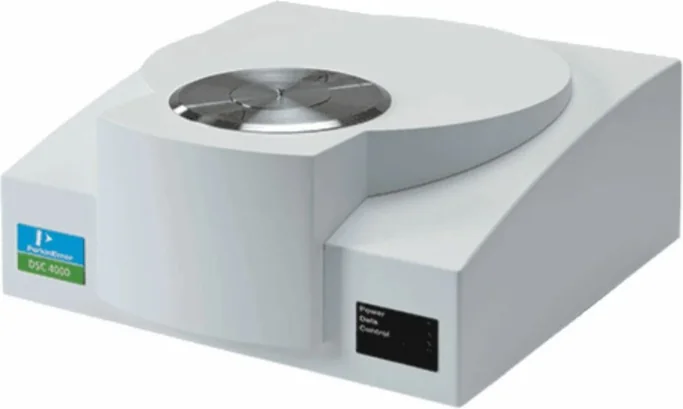
Differential scanning calorimetry (DSC) is a thermoanalytical technique that measures the difference in heat flow required to increase the temperature of a sample and a reference as a function of temperature. It detects exothermic and endothermic transitions such as glass transitions, melting, crystallisation and curing, providing crucial data on thermal stability, composition and purity.
The technique measures the heat-flow difference between a sample and a reference while both follow the same controlled temperature programme, enabling precise identification of thermal transitions.
How it works
Heat flow measurement
Measures the difference in heat flow between the sample and a reference during controlled heating or cooling.
Thermal transitions
Detects glass transition, melting, crystallisation, curing and other endothermic or exothermic events.
Material characterisation
Evaluates thermal stability, composition, purity and phase behaviour with high accuracy.
DSC is used extensively across pharmaceutical, polymer, food, chemical and materials industries for quality control, R&D, product formulation and thermal analysis.
At a glance
| Measures | Heat flow vs temperature / time |
|---|---|
| Detects | Tg · melting · crystallisation · curing |
| Service | Purity, polymorph & thermal transition studies |
Have a sample or a complex analytical question?
Share your requirement and our scientists will come back with the right technique, timeline and quotation.