
Analytical services, synthesis & formulation
Specialised scientific solutions with advanced technology and expert scientists — supporting research, innovation and high-quality pharmaceutical development.
Analytical services
Advanced analytical testing using modern instrumentation to ensure reliable and accurate results — method development, validation and routine testing for raw materials, intermediates, APIs and finished formulations.
See instrumentsCustom synthesis
Small-scale synthesis of organic compounds and labelled APIs for research and pharmaceutical development, including custom synthesis, impurity profiling and problem-solving studies.
Discuss a moleculeFormulation development
Development of robust formulations and optimal dosage forms to reduce cost and development timelines.
Start a projectState-of-the-art chromatographic & spectroscopic instruments
From method development and validation to full structural characterisation — every technique is run by experienced scientists under traceable workflows.
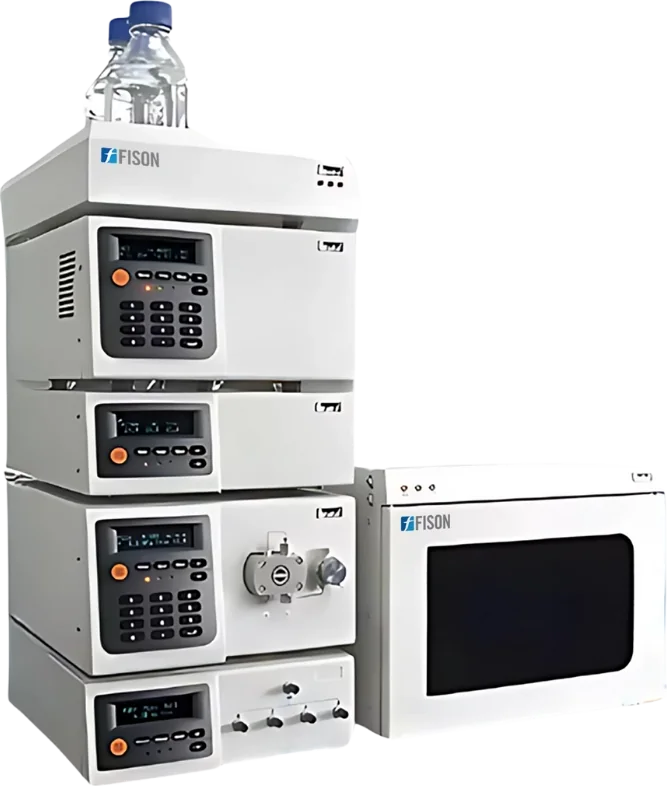
High Performance Liquid Chromatography
Separates and quantifies components in a liquid mixture using a pressurised mobile phase — the workhorse of pharma QC and R&D.
- UV, fluorescence & refractive index detection
- High-pressure pump-driven mobile phase flow
- Accurate separation & quantification of compounds
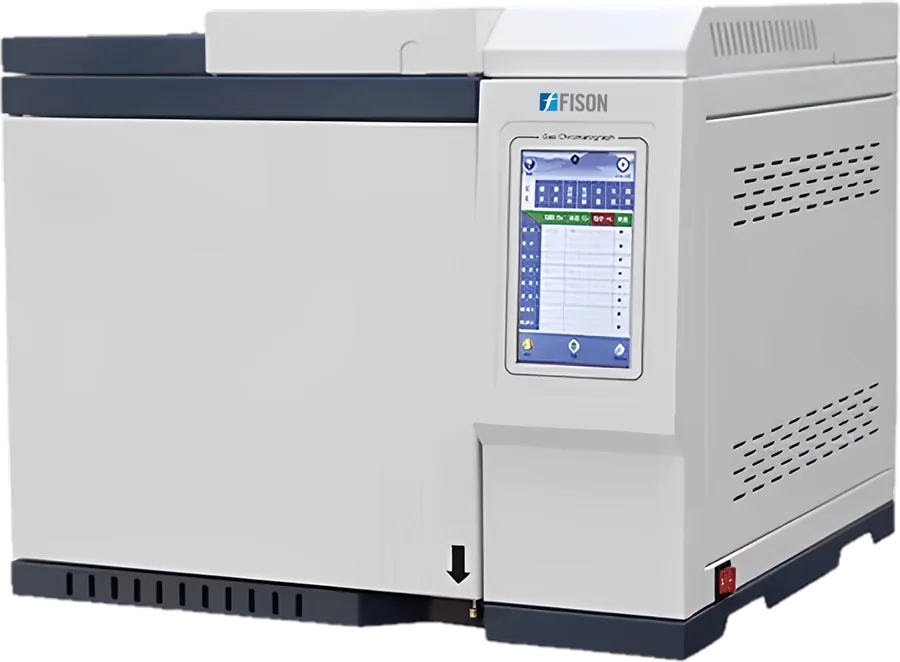
Gas Chromatography
Separates volatile compounds by vaporising them and passing them through a column with an inert carrier gas.
- FID, NPD & TCD detectors
- Temperature-controlled oven for precise separation
- High precision for industrial & research applications
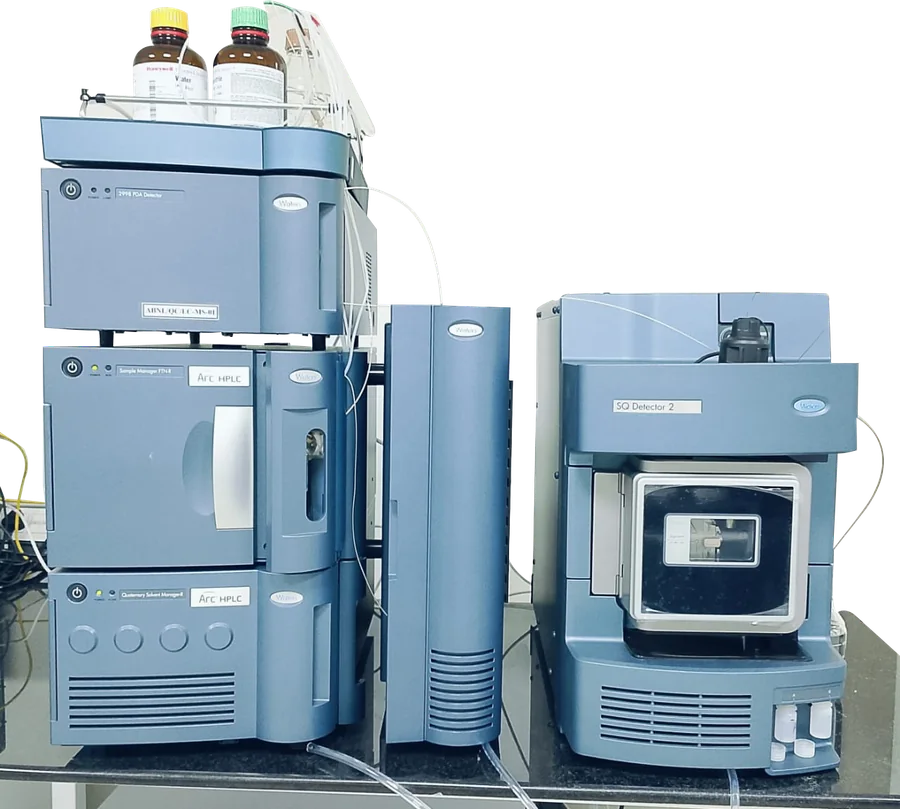
Liquid Chromatography – Mass Spectrometry
Combines LC separation with highly sensitive mass detection for ultra-trace quantification below ppb levels.
- ESI, APCI & APPI ionisation interfaces
- Selective detection with reduced separation need
- Compound identification via m/z
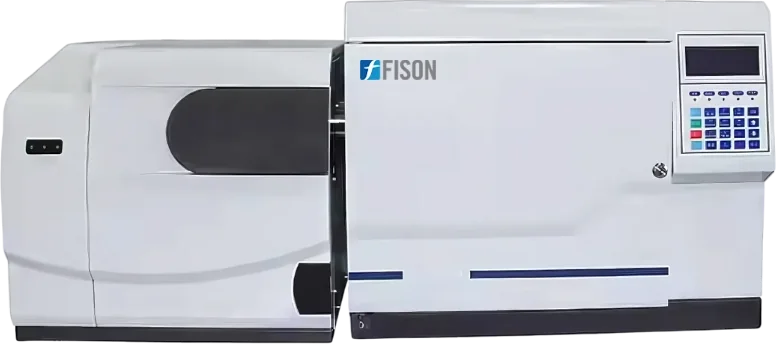
Gas Chromatography – Mass Spectrometry
Identifies volatile and semi-volatile compounds in complex mixtures from their retention times and distinct mass spectra.
- Electron ionisation (EI) & chemical ionisation (CI)
- Capillary column for high-resolution separation
- Precise compound ID in complex samples
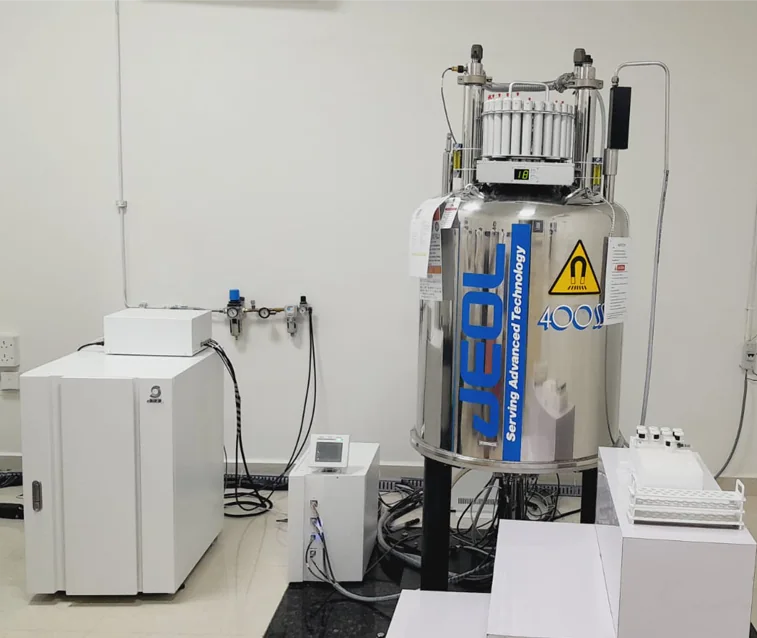
400 MHz FT-NMR Spectrometer
Determines the structure of organic compounds by observing how nuclei behave in a magnetic field — 1D and 2D techniques.
- 1D: ¹H, ¹³C, ³¹P, ¹⁹F, DEPT, APT, qNMR
- 2D: COSY, HSQC, HMBC, NOESY, TOCSY
- Solvents: CDCl₃, DMSO-d₆, D₂O, CD₃OD & more
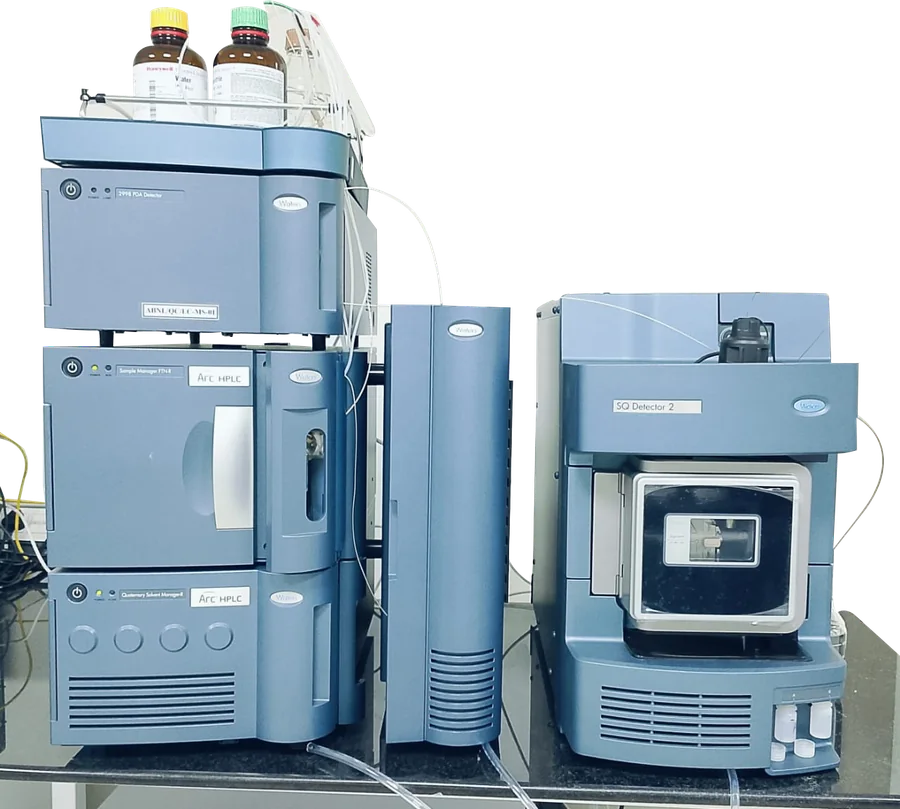
Mass Spectrometry
Identifies unknown compounds and molecular structures by converting samples into ions and measuring their mass-to-charge ratios.
- ESI & APCI probes for polar / non-polar compounds
- Relative abundance vs m/z spectrum output
- Confirms compound identity & molecular structure
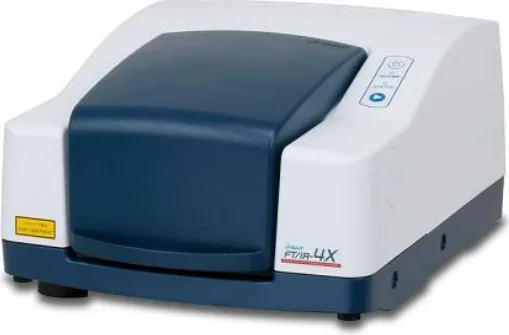
Fourier Transform Infrared Spectroscopy
JASCO FTIR-4X with ATR PRO 4X and 21 CFR compliance — identifies organic, polymeric and inorganic materials.
- Spectral range 7800–350 cm⁻¹ (standard)
- Resolution 0.4–16 cm⁻¹, S/N ratio 35,000
- Identifies functional groups & molecular structure
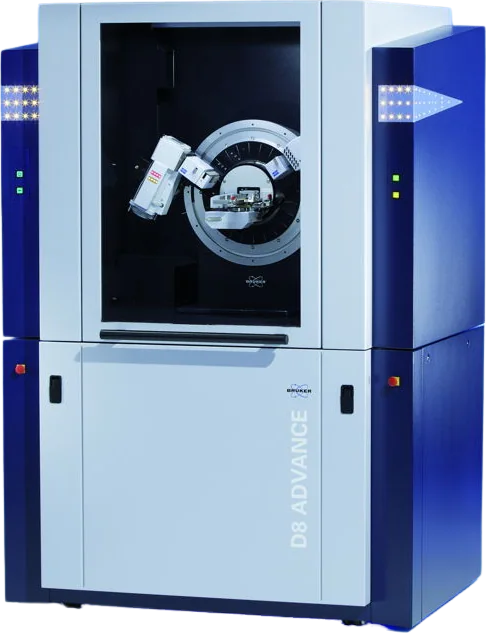
X-ray Diffraction
Non-destructive determination of phase composition, crystal structure and lattice parameters of crystalline materials.
- Monochromatic X-ray irradiation of samples
- Unique diffraction patterns at specific angles
- Phase ID, crystal structure & lattice parameters
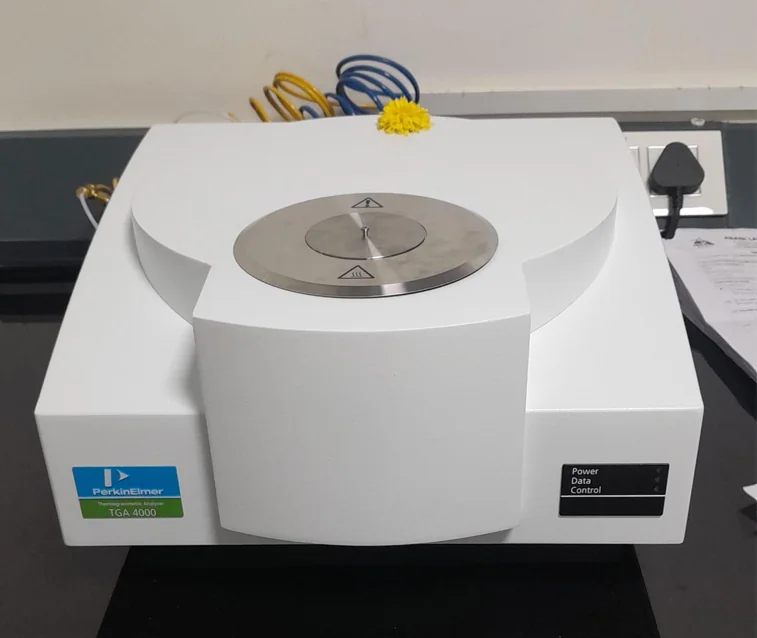
Thermogravimetric Analysis
Measures weight change as temperature rises — thermal stability, moisture content and volatile components.
- Decomposition via oxidation, evaporation & combustion
- Moisture & volatile component detection
- Thermal stability & heat resistance profiling
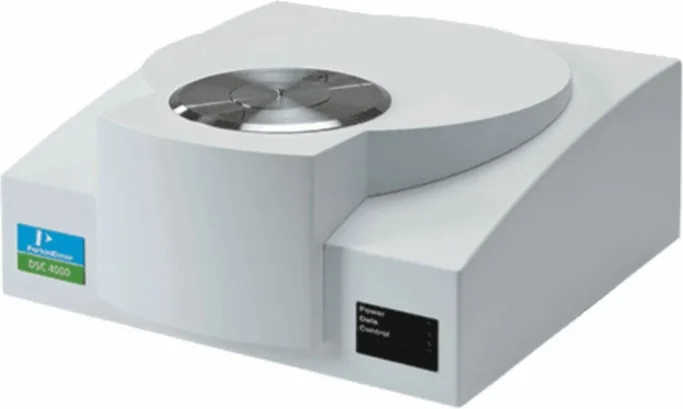
Differential Scanning Calorimetry
Measures heat flow into or out of a sample during controlled heating or cooling to evaluate thermal transitions.
- Detects melting, crystallisation & glass transition
- Heat flow versus temperature or time
- Thermal stability & phase transition studies
Have a sample or a complex analytical question?
Share your requirement and our scientists will come back with the right technique, timeline and quotation.